Board Game Dice: Role Playing Different Strategies for Tabletop Mastery and Real-World Decision-Making
The satisfying clatter of dice on a tabletop does more than decide a sword strike or a saving throw. For game masters, designers, educators, and even entrepreneurs, Board Game Dice. Role Playing Different is not just a product description—it is a lens for strategic thinking. Whether you curate a role playing different sided game dice collection for immersive storytelling or use polyhedral dice as analog randomizers in workshops, the choices you make about shape, color, and probability carry practical weight. This article unpacks why these small objects hold oversized strategic value and how to apply that insight beyond the gaming table.
Why Polyhedral Dice Form the Backbone of Intentional Game Design
Standard six-sided dice deliver flat probability: each face has an equal 16.67% chance. Once you add a d4, d8, d10, d12, or d20 to the mix, you are no longer rolling—you are engineering outcomes. Game systems like Dungeons & Dragons and Pathfinder lean on these curves to simulate skill, luck, and heroic failure. The d20, for instance, turns every action into a high-stakes 5% increment. A d4 often represents the fragile spark of a magic missile or a desperate dagger. Understanding this spectrum helps designers match mechanics to narrative feel.
When you build a Board Game Dice. Role Playing Different collection, you are effectively assembling a probability toolkit. A brand strategist might use a d20 in a prioritization exercise, mapping 1–5 to “delegate,” 6–10 to “postpone,” 11–15 to “test,” and 16–20 to “execute now.” An educator could let students roll a d8 to determine which discussion prompt they tackle, injecting low-stakes randomness that boosts engagement without chaos. The key is not the dice themselves, but the deliberate mapping of results to meaningful actions.
Strategic Value of a Curated Dice Collection
A scattered bag of mismatched dice creates friction. A thoughtfully curated role playing different sided game dice collection, on the other hand, functions like a well-organized inventory. Gamers know that rolling 8d6 for fireball damage feels different from rolling 2d12 for a greatsword, even if the averages are close. The tactile and visual feedback shapes player emotion. For game masters, having distinct dice for specific NPCs or environmental hazards reduces cognitive load and speeds up play—a direct productivity gain.
Beyond the table, small business owners and marketers can adopt this logic. Consider your customer touchpoints as different dice: a d20 for high-impact campaigns, a d4 for low-risk social media experiments, a d8 for mid-level A/B tests. Assigning a “die type” to a decision helps you calibrate the level of risk and potential reward before committing resources. This mental model moves you away from binary go/no-go thinking and toward probability-based portfolio management. It is a low-tech decision framework rooted in the same principles that make a dungeon crawl exciting rather than arbitrary.
Role-Playing Different Sides: How Shape Influences Perception and Planning
The geometry of a die communicates intent before it even lands. A d4 pyramid suggests precision and small impact. A d12, with its broader faces, feels weightier and more forgiving. A d20 is iconic for do-or-die moments. When you present a Board Game Dice. Role Playing Different set to players, you are subtly guiding their emotional investment. This is critical for experience designers, event facilitators, and even product managers who need to frame uncertainty.
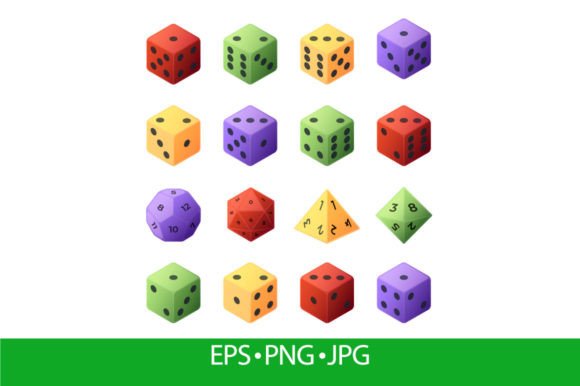
For example, a facilitator leading a strategy offsite might use a giant inflatable d6 for group decisions—low stakes, visible, communal. Switching to a smaller metal d20 for individual accountability changes the room’s energy. The same principle applies to digital interfaces: apps that simulate dice rolls for habit tracking or daily challenges often succeed because they lean into the familiar polyhedral language. The Vector polyhedral dices isolated set is not just a design asset; it is a communication tool. Designers can incorporate these clear, colorful shapes into dashboards, slide decks, and instructional materials to signal chance, gamification, or probabilistic thinking without a single line of code.
Practical Use Cases Across Gaming, Education, and Business
- Tabletop role-playing campaigns: Use specific dice colors for specific conditions (poisoned, blessed, exhausted) to create instant visual feedback for players. This reduces rule-checking and keeps narrative momentum.
- Creative writing and world-building: Build a dice drop table for plot twists. Roll a d4, d6, and d8 simultaneously; the combination gives 192 possible story seeds, enough for a full campaign arc while avoiding predictable patterns.
- Classroom engagement: Replace cold-calling with a d20 roll where each student is assigned a number. The randomness is perceived as fair, and the playful tension improves attention.
- Agile retrospectives: Teams roll a d8 mapped to reflection prompts (“What slowed us down?” “Where did we exceed expectations?”). The physical act of rolling creates a ritual that separates reflection from blame.
- Marketing gamification: A loyalty program that awards “rolls” for purchases—customers trigger a digital polyhedral die and unlock tiered rewards. The varied probabilities echo the excitement of opening a booster pack.
Designing for Long-Term Value: Building a Dice Ecosystem
Smart collectors think beyond aesthetics. A robust role playing different sided game dice collection should cover the mechanical needs of your most-played systems while leaving room for serendipity. If you run gritty horror games, invest in muted, legible dice with high contrast—function over flash. For family board games, oversized, easy-to-read dice with rounded corners reduce frustration and lost pieces. For prototyping new tabletop games, buy bulk sets of cheap polyhedrals to test probability curves before committing to custom manufacturing.
This ecosystem thinking translates to digital asset management as well. Designers and publishers often need Vector polyhedral dices isolated set graphics for rulebooks, Kickstarter pages, and social media promos. Having a consistent visual language—a d6 for simple tasks, a d20 for saving throws—across all materials reinforces brand identity. When you purchase or create a set in EPS, PNG, and JPEG formats, you future-proof your content. The EPS gives scalability; PNGs support transparent overlays for video; JPEGs work for quick web placement. Treating these files as reusable components, not just one-off illustrations, aligns with strategic resource management principles found in any mature design system.
When Randomness Serves Goals, and When It Undermines Them
There is a seductive trap in loading up on novelty dice: oversized liquid-core d20s, spin-down dice, dice-within-dice. Each has a purpose (spin-downs for life counters, nesting dice for quick multi-rolls), but without a clear goal, they become clutter. The same is true in strategy work. Introducing a random element without tying it to a decision framework leads to the illusion of action. I have watched teams “roll” for sprint priorities and then immediately overrule outcomes that felt inconvenient, eroding trust in the process.
Before relying on Board Game Dice. Role Playing Different as a planning tool, define your boundaries. Which outcomes are truly equal in viability? If a roll suggests cutting a core feature to meet a deadline, will leadership accept that? If not, do not put that option on the table. Use dice to break ties, not to make commitments you cannot honor. In game design, this manifests as failing forward—ensuring that a failed roll does not stop the story but redirects it. In business, it means using chance to surface options you might otherwise overlook, while reserving veto power for ethical, financial, or strategic misalignment.
The Psychology of Tangible Randomization
In an era of AI predictions and data-driven dashboards, the physical act of rolling a die feels almost rebellious. It reconnects us with uncertainty in a manageable container. This is why even casino gambling pieces—craps dice, roulette balls—retain their mystique despite digital simulations being perfectly fair. The chips, the felt, the clatter all anchor the experience in reality. When you hold a colorful realistic cube with dots in your palm, you engage a part of your brain that digital alternatives cannot reach. For family gaming, that tangibility builds shared memories; for professionals, it can reset a meeting that is spinning into analysis paralysis.
Consider the subtle influence of material: heavy metal dice convey permanence and importance. Acrylic dice with sharp edges feel precise and demanding. Wooden dice soften the experience and suit more narrative, low-conflict games. Matching the tactile profile to the intended outcome—serious strategic planning vs. creative ideation—is an underleveraged design choice. When you source Vector polyhedral dices isolated set graphics for a workshop deck, try to reflect that material quality in the illustration style. A flat, cartoonish d20 sets a different expectation than a photorealistic rendering with shadows and reflections.
Integrating Dice Assets into Content and Branding
For publishers, bloggers, and course creators, dice imagery is more than decoration. It is a visual shorthand for concepts like chance, strategy, gaming, education, and critical thinking. A blog post on overcoming creative blocks might feature a hand rolling a handful of polyhedral dice against a minimalist background, instantly signaling “embrace randomness to break patterns.” A SaaS onboarding flow could use a subtle d20 icon next to onboarding steps that involve exploration, indicating a low-risk trial period where users are encouraged to experiment.
When you license or create a role playing different sided game dice collection as vector art, you gain the flexibility to scale these metaphors across print, web, and merchandise. An EPS file can produce a billboard-sized die graphic without losing crispness. A PNG with transparency can overlay a video explainer without clashing with the background. A JPEG works for quick email headers. Having all three formats means you never have to compromise visual quality due to platform limitations. This is the same logic as a versatile dice bag: carry what you need for any encounter, and you will never be caught off guard.
Avoiding the Over-Optimization Trap
It is tempting to spreadsheet every dice set you own: average roll, standard deviation, ideal use case. But obsessing over mathematical perfection can drain the soul from gaming. The most memorable moments often come from extreme results—the natural 20 that saves the party or the cluster of 1s that sends a masterwork plan up in flames. Similarly, in creative work, protecting yourself from all failure guarantees that you also miss the unplanned breakthroughs. Use Board Game Dice. Role Playing Different to create safe spaces for volatility, not to eliminate it.
For entrepreneurs, this might mean setting aside a small innovation budget where you explicitly roll the dice on unconventional ideas, knowing many will fail. The die roll acts as a commitment device; you agree in advance that a roll in the top 30% triggers a small experiment, no debate. Over time, this builds a culture that respects both data and intuitive leaps, with the dice serving as a neutral arbiter.
When Context Dictates the Right Die
Not every situation calls for a d20. If you are running a tense negotiation scene, a single d100 roll (using two d10s for percentile) turns every point of persuasion into a calculated gamble that players feel viscerally. If you are teaching probability to middle schoolers, starting with d6s and gradually introducing other polyhedrals makes abstract concepts tangible. The strategic move is matching the die to the learning goal, the narrative beat, or the business decision’s complexity. Low-impact, high-frequency decisions can use a d4 or d6; high-stakes, infrequent calls warrant a d20 or percentile approach.
This principle extends to planning cycles. Annual strategic planning might benefit from a “d100” mindset—thinking in probabilities and ranges rather than certainties. Weekly task prioritization aligns better with a d8 approach: rapid, bounded choices. Your role playing different sided game dice collection becomes a physical reminder to calibrate your decision-making apparatus to the scale of the challenge, rather than treating every choice as a life-or-death d20 roll.
Building Your Own Decision Dice Toolkit
- Audit your existing decisions. For one week, jot down moments where you were stuck. Did you have enough information? Was the cost of delay high? These are candidates for dice-driven breaks.
- Assign outcomes that matter. Never roll for something with no consequence. If all options are fine, flip a coin. Use dice when you need a weighted, multi-outcome resolution.
- Design for visibility. If you use dice in a team setting, make the mapping public. A whiteboard with “d8 Innovation Prompts” normalizes the process and reduces facilitator bias.
- Select the right assets. If your work involves digital content, invest in a Vector polyhedral dices isolated set that aligns with your brand palette. Having on-demand EPS, PNG, and JPEG files keeps your content production agile.
- Reflect and iterate. After a trial period, review which dice-driven decisions worked. Keep the ones that added clarity or momentum; discard those that felt forced. The goal is a refined system, not a gimmick.
A thoughtfully placed dice roll is a strategic asset disguised as a toy. When you understand the interplay of shape, probability, psychology, and design that Board Game Dice. Role Playing Different represents, you can apply that understanding well beyond the game table. It becomes a quiet, flexible tool for framing uncertainty, encouraging participation, and making peace with imperfection—all while delivering the simple joy of watching a polyhedron tumble to a stop.