Understanding and Applying Young Characters Addicted to Social Media in Modern Design Workflows
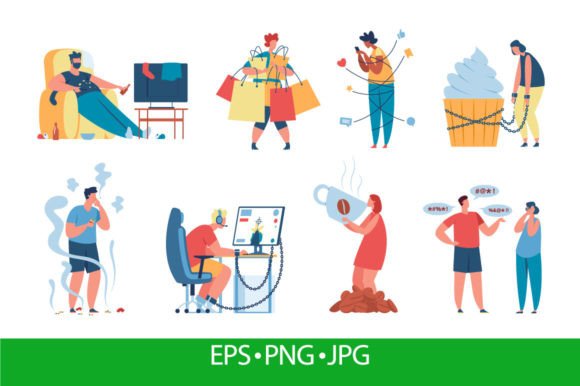
Visual storytelling has shifted dramatically in the past decade. When you need to communicate complex behavioral patterns—like digital dependency, compulsive shopping, or substance habits—the right illustration does the heavy lifting before a single word is read. The Young Characters Addicted to Social concept has emerged as a go-to visual shorthand for designers, educators, and content creators who need to address screen-bound behaviors with clarity and empathy. This collection of illustrated characters, typically depicting teens and young adults absorbed in phones, gaming consoles, streaming platforms, cigarettes, coffee cups, and shopping bags, serves as a versatile asset across multiple formats including EPS, SVG, PNG, and JPEG.
What makes these vector sets particularly useful is their flexibility in format and application. An EPS file gives you infinite scalability for print materials without losing fidelity. SVG versions integrate cleanly into web projects with minimal load impact and easy CSS manipulation. PNG files provide transparency for layered compositions in presentations or social media graphics, while JPEG versions offer compressed, ready-to-use options for quick deployment in blogs, emails, or slide decks. Understanding which format to reach for—and when—saves hours of rework and keeps your creative pipeline flowing.
Where Addiction-Themed Character Illustrations Fit Into a Broader Creative Process
These assets are not standalone curiosities. They operate within a larger ecosystem of planning, discovery, design, and delivery. Before you ever open an SVG file, the real work begins with clarifying what you are trying to say about addiction, habit formation, or mental health. Are you building an awareness campaign about screen time? Designing a presentation deck for parents? Creating social media content for a wellness brand? The answer determines how you select, combine, and sequence these visuals.
The Young Characters Addicted to Social theme covers a spectrum: a teenager curled on a couch binge-watching TV, a young professional unable to step away from a shopping app, a student chain-smoking during late-night gaming sessions, a caffeine-dependent creative juggling multiple screens. Each character represents a different entry point into a conversation about compulsive behavior. Your job as the implementer is to map those characters to specific messages, audiences, and platforms.
Pre-Project Planning: Defining the Role of Visual Addictions in Your Message
Before downloading any asset pack, clarify the narrative arc. If you are a marketer preparing a quarter-long content series on digital wellness, you might sequence the illustrations from casual overuse to visible consequences. A blogger writing about personal productivity might use a single hero image of a character trapped between social media notifications and an overflowing coffee cup. An educator developing curriculum materials might need a consistent cast of characters who appear across multiple lessons, reinforcing recognition and emotional connection.
This planning phase is where format decisions start mattering. For a blog or email newsletter, JPEG and PNG files are the pragmatic choice—they load fast and integrate with any CMS. For a printed workbook or poster series, EPS files become essential because your printer will require vector artwork for crisp output at any size. For an interactive webpage where the character illustrations need to change color on hover or respond to user input, SVG is the only format that gives you that level of code-level control without degradation.
During the Project: Integration With Tools, Platforms, and Other Assets
Once you have selected the right vector set, the practical integration work begins. These illustrated addiction concepts rarely stand alone. They interact with typography, color palettes, data visualizations, charts, icons, and photography. A character addicted to gaming might sit next to a statistic about average weekly screen time among teenagers. A shopping-addicted figure might appear beside a call-to-action about financial literacy resources. The key is treating the character illustrations as narrative anchors, not decorative afterthoughts.
In Figma, Sketch, or Adobe Illustrator, you can pull the EPS or SVG files directly into your artboard and scale them without pixelation. This is especially important when you are designing for multiple screen sizes or print dimensions. A social media carousel might use four PNG versions of the same character in different poses—scrolling, gaming, watching TV, holding a coffee cup—to create a visual story arc across slides. Meanwhile, the same campaign's landing page might use a single SVG version that loads in under 20KB and animates subtly on scroll.
Compatibility considerations extend beyond software. Think about how these character illustrations will coexist with brand guidelines. Many vector sets allow color customization, especially through SVG and EPS files where you can adjust fill colors, stroke weights, and even simplify shapes for minimalism. If your brand uses a muted, desaturated palette, you may need to modify the original artwork to avoid clashing. If your audience responds better to diverse character representation, look for sets that include variations in skin tone, body type, and styling—or select formats that make customization straightforward.
Content Marketing and Social Media Campaigns
A content marketer building a campaign around digital detox might use the Young Characters Addicted to Social illustrations as the visual centerpiece of a five-part Instagram series. Day one features a character drowning in notifications. Day two shows the same character putting the phone down and experiencing nature. The PNG format works here because Instagram's compression algorithm handles raster images predictably, and you need the transparency to layer characters over photographic backgrounds or branded gradient overlays.
For a blog post, the JPEG format often makes more sense—smaller file size, faster page loads, and no need for transparency when the image sits within a content column on a white background. The article's header might feature a composite of three characters: one gaming, one shopping, one vaping or smoking, visually representing the breadth of behavioral addictions the post will address. This composite can be assembled in Canva or Photoshop using elements from the vector set, then exported as a single optimized JPEG.
Educational and Training Materials
Educators designing workshops on media literacy or addiction awareness frequently need consistent visual language across handouts, slide decks, and online modules. An EPS file becomes the master asset here. Import it into PowerPoint, Keynote, or Google Slides, and you can resize the character illustrations for title slides, section dividers, and in-slide examples without ever worrying about jagged edges. The same EPS file can be sent to a print shop for a take-home brochure, where the character art needs to hold up at 300 DPI on coated paper.
For online course creators, SVG files offer an additional advantage: they can be animated with simple CSS or JavaScript. A character representing phone addiction might have a subtle pulse animation around the screen area, drawing the learner's eye to the focal point of the addiction narrative. This kind of micro-interaction, when used sparingly, improves engagement and reinforces the educational message without becoming distracting.
Health, Wellness, and Productivity-Focused Projects
Coaches, therapists, and wellness bloggers often need to address addiction topics with sensitivity and precision. The Young Characters Addicted to Social illustrations provide a buffer—a degree of separation that allows audiences to engage with difficult topics without feeling personally exposed. A productivity consultant might build a workshop slide that contrasts a character trapped in a cycle of gaming and caffeine consumption with a character practicing mindful routines. The before-and-after visual structure is instantly legible, reducing the need for lengthy explanations.
In these contexts, usability and emotional tone matter deeply. Choose illustration styles that avoid caricature or mockery. The goal is to depict compulsive behaviors recognizably without stigmatizing the person experiencing them. Look for vector sets where the character expressions convey absorption or fatigue rather than ridicule. When you place these illustrations alongside practical advice—like screen time management techniques or habit replacement strategies—the visuals support the message rather than sensationalizing it.
Long-Term Asset Management and Quality Control
Once you have acquired a vector set depicting young characters with various addictions—social media, gaming, TV, tobacco, shopping, caffeine—treat it as a reusable library, not a one-off download. Organize the files by format and theme. Label folders clearly: social-media-addiction-svg, gaming-addiction-png, smoking-addiction-eps, and so on. This upfront organization pays dividends six months later when you need to quickly pull a character for a new campaign or client project without re-downloading or re-purchasing.
Quality control is an ongoing practice. Check that the EPS files open correctly in your primary design tool. Verify that SVG files render consistently across Chrome, Safari, and Firefox, especially if they include gradients or complex paths. Test PNG transparency against different background colors in your most common use scenarios. If a JPEG version shows compression artifacts at the size you need, switch to a higher-resolution PNG or the original vector source and export again with adjusted settings.
Consistency across projects is another factor. If you are using these character illustrations in a recurring newsletter, maintain the same scaling, positioning, and color treatment from issue to issue. Your audience builds visual familiarity over time, and that familiarity increases trust and engagement. Changing the art style or format midway through a campaign introduces subtle friction that works against your communication goals.
Making the Characters Work Within Realistic Constraints
Not every project has unlimited design resources. If you are a freelancer or small business owner handling your own creative work, the efficiency gains from a well-organized vector set are substantial. Instead of commissioning custom illustrations for every blog post or client deliverable, you can pull from a library of addiction-themed characters, adjust colors and compositions, and produce professional-looking materials in a fraction of the time. The key is knowing the limitations: stock-style illustrations work best when they support original insights, data, or recommendations. Do not let the artwork carry the entire weight of the message.
When working with addiction-related content, pair these visuals with credible sources, up-to-date research, or personal expertise. A blog post that combines Young Characters Addicted to Social illustrations with statistics from reputable health organizations, practical habit-change frameworks, and thoughtful analysis will far outperform one that simply describes the images. The visuals draw people in. The substance makes them stay, share, and return.
For those working across international audiences, consider cultural variations in how addiction is perceived and depicted. A character holding a cigarette might require different contextual framing in regions with stricter tobacco advertising laws or different public health messaging. SVG and EPS formats give you the control to modify or omit elements that do not suit your audience, making them preferable for globally distributed content.
Expanding Beyond the Core Addiction Themes
The vector set concept described—covering social media, gaming, TV, smoking, shopping, and caffeine addictions—serves as a foundation. In practice, you may find yourself combining these characters with other visual assets to represent more complex, overlapping patterns. A single illustration might depict a character simultaneously gaming, holding an energy drink, and ignoring a pile of unopened mail. Another might show a young adult cycling through a phone, a shopping website, and a TV remote in rapid succession, capturing the fragmented attention that characterizes modern compulsive behavior.
This combinatorial approach increases the lifespan of your asset library. Rather than needing a specific illustration for every imaginable scenario, you can layer and juxtapose existing characters to create new meanings. A gaming-addicted character placed next to a shopping-addicted character begins to tell a story about how different compulsions feed off each other, often rooted in the same underlying emotional triggers. This is where the creative process moves from simple illustration selection into genuine visual communication design.
Preparing for Cross-Platform Distribution
One final but critical consideration: the same character illustration will render differently on a Retina display versus a standard monitor, a high-end smartphone versus a budget tablet, a printed flyer versus a projected slide. Test your chosen formats across the output channels your project requires. A PNG that looks crisp on your laptop might appear soft on a 4K external display if the resolution is insufficient. An SVG with complex clipping paths might render incorrectly in older email clients that strip or simplify vector code. These are not reasons to avoid the formats—they are reasons to test early and adjust exports before final delivery.
The EPS, SVG, PNG, and JPEG formats each occupy a specific role in this testing process. EPS for print proofing. SVG for responsive web and animation. PNG for layered digital compositions and transparent overlays. JPEG for final-stage deployment where file size and broad compatibility matter most. Knowing these roles transforms a simple vector purchase into a genuinely integrated part of your creative toolkit.