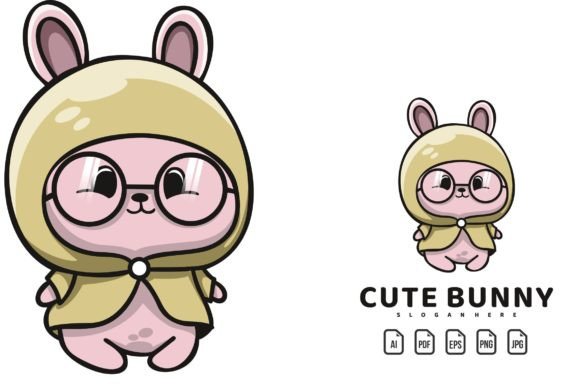
The Versatile Power of a Customizable Cute Bunny Mascot Logo
In the landscape of visual branding and character design, mascots serve as powerful ambassadors. They embody personality, convey values, and create immediate emotional connections with an audience. Among these, the imagery of a cute bunny mascot logo holds a particularly unique and wide-ranging appeal. Its inherent characteristics of friendliness, agility, and playful charm make it a surprisingly robust foundation for a multitude of projects. This discussion explores the practical utility and real-world relevance of a fully editable cute bunny mascot logo template, moving beyond its charming facade to examine its structural advantages and diverse application potential.
Core Characteristics of an Effective Bunny Mascot Design
A successful mascot, regardless of its form, operates on several key principles. It must be memorable, scalable across different media, and adaptable to the tone of its brand or project. The archetype of a bunny naturally brings several of these traits to the forefront.
First, the symbolism is universally accessible. Bunnies are often associated with positive attributes like speed, gentleness, curiosity, and vibrancy. These traits can be cleverly leveraged. For a gaming character, the speed translates to agility and quick reflexes. For a sports team, it might symbolize fast-paced play and energetic teamwork. In apparel, it evokes a sense of casual, friendly style. This inherent symbolic flexibility is a significant starting advantage.
Second, the visual form of a bunny—with distinct ears, a compact body, and expressive features—is inherently recognizable even at a simplified level. This makes it an excellent candidate for logo design, where clarity and quick identification are paramount. A well-designed cute bunny mascot logo balances this recognizability with unique stylistic touches that set it apart.
The Engine of Adaptability: Fully Editable Vector Files
The true power of a modern logo template lies not just in the initial design, but in its capacity for modification. This is where technical specifications directly enable creative and professional application. A template offering 100% scalable vector files, where everything is editable, changes the asset from a static image into a dynamic design toolkit.
Vector graphics, unlike standard image files, are defined by mathematical paths rather than pixels. This means they can be resized to any dimension—from a tiny app icon to a large billboard print—without any loss of quality or sharpness. The statement “everything is resizable” is a practical guarantee of consistency across all output mediums. Furthermore, when every element is editable, the designer has control over contours, colors, and composition. You can adjust the bunny’s pose, modify the expression in its eyes, or reshape elements to better align with a specific brand identity. The inclusion of multiple file formats like AI, EPS, PNG, and JPG ensures compatibility with major design software, print workflows, and digital platforms.
Primary Use Cases and Industry Applications
The utility of such a malleable asset becomes clear when examining its potential journeys across different sectors. Each application leverages the core bunny motif while tailoring it through the editable features.
Game Character Design and Gaming Communities
In gaming, mascots often become central figures for teams, streamers, or indie game studios. A cute bunny mascot logo can serve as a profile avatar, channel logo, or even the foundational sketch for a game’s protagonist or companion character. Its editable nature allows game developers to iterate on the design. Colors can be shifted to match a game’s palette; details can be added or simplified to fit different art styles (from pixel art to high-rendered 3D models); and the logo can be consistently used across marketing materials, merchandise, and in-game UI. The associated “free font download” mentioned in template features is particularly useful here, allowing the game’s title or tagline to be integrated seamlessly with the mascot’s visual style, creating a cohesive brand package.
Sports Teams and Athletic Branding
Sports logos require energy, team spirit, and a sense of movement. A bunny mascot, when edited appropriately, can exude all these qualities. By perhaps emphasizing more dynamic lines, choosing bold and vibrant colors, and integrating sport-specific elements (like a ball or athletic gear) into the editable framework, the logo becomes unique to the team. The scalability ensures it looks perfect on a jersey embroidery, a website header, and a large stadium banner. For community leagues, school teams, or fitness groups, this approach offers professional-grade branding without prohibitive design costs.
Apparel and Merchandise Lines
The fashion and merchandise sector thrives on recognizable, appealing graphics. A cute bunny mascot logo is a naturally attractive image for T-shirts, hats, patches, and accessories. Its editable color palette means it can be adapted to match seasonal collections or specific fabric colors. The vector basis guarantees that printing processes, whether screen printing or digital transfer, receive a high-quality file that will reproduce cleanly. For entrepreneurs launching a casual wear brand or a fan creating community merch, having an editable logo template provides complete control over the final product’s look.
Practical Considerations for Implementation
Adopting a ready-made template requires a thoughtful approach to maximize its value while ensuring originality. A key consideration is the depth of customization. While the template provides the structural “bones” of the cute bunny mascot logo, the final personality comes from how you alter it. Experiment with color psychology: softer pastels for a child-friendly app, neon accents for an esports team, monochrome for a minimalist apparel line. Use the editable text features alongside the downloaded font to create a typographic lockup that feels unique.
Another vital step is consistency across applications. Once you have finalized your edited version, use the various included file formats correctly. The AI or EPS files are your master files for future edits or high-end print. The PNG is ideal for digital use with transparent backgrounds. The JPG can serve for certain web contexts. Maintaining a library of these consistent files for all your branding needs is a best practice.
It’s also wise to consider context. While the bunny mascot is versatile, its final design should feel intentional for its niche. Research competitors or similar entities in your field. Your customization should aim to differentiate your project, using the template’s flexibility to create a logo that feels owned and specific, not generic.
Workflow from Template to Finished Asset
A typical workflow might begin by opening the master vector file (AI or EPS) in your preferred design software. The first edits are often conceptual: deciding on the core message your bunny should convey. Next, technical edits follow: resizing elements, changing stroke weights, altering the color scheme using the editable color features. Then, you integrate text. Utilizing the provided font information, you download the font and replace any placeholder text with your actual brand or character name. This step is crucial for achieving a unified look. Finally, you export the specific file formats needed for your current projects, always preserving your master edited file for future needs.
Throughout this process, the excellent quality of the original vector work ensures that your modifications do not degrade the image. Clean paths and proper layering in the template make professional-level customization accessible even to those with moderate design experience.
The Broader Relevance in Digital Creation
Beyond specific industries, the availability of such editable mascot templates reflects a larger trend in digital creation. It empowers a wider range of creators—from hobbyists designing for a community forum to business owners crafting a brand identity, to educators creating visual materials for a program—with high-quality starting assets. It reduces the barrier to professional visual design, allowing focus to shift from drawing initial forms to refining and applying them with purpose.
A cute bunny mascot logo, therefore, starts as an inviting image but transforms through its technical specifications into a versatile tool. Its relevance is confirmed by its journey across contexts: from a sprite in a game, to an emblem on a team jersey, to a graphic on a popular hoodie. Each iteration, enabled by its editable and scalable nature, carries the core charm of the mascot while wearing the distinct identity of its final application. This combination of inherent appeal and structural flexibility makes it a persistently useful resource in the toolkit of modern creators and brands.